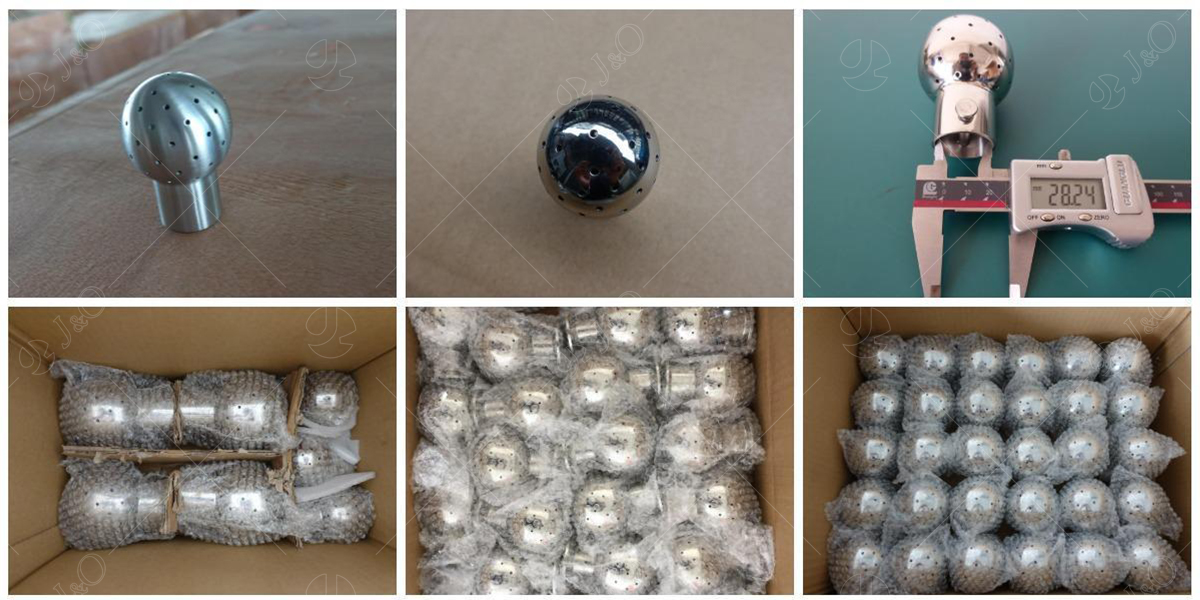
Selection Of Cleaning Balls With Different Spray Angles
- Model:
- JOF-CBH001-11
- Brand:
- J&O
- Material:
- SS304 or SS316L
- Connection:
- Welded
- Payment:
- T/T, L/C, Western Union


A spray ball angle must match tank geometry, not tank volume. Choose 180° for side-entry ports on shallow vessels, 270° for vertical cylinders with a domed top, and 360° for full coverage with a top-center mount. SS304 or SS316L bodies with welded connections support all three patterns. Install steps: confirm minimum flow, hold rated pressure, mount at the centerline, clear the agitator sweep, and run a riboflavin coverage test.
Why Tank Geometry Sets the Spray Pattern
Cleaning depends on impingement, not on flooding the tank. Each nozzle hole directs a jet at a defined angle. Coverage comes from the sum of those jets. Dome and cone heads need upward jets, cylindrical walls need radial jets, and tank bottoms need downward jets. Manway and agitator shadows need extra nozzles. A cip spray ball placed at the top center reaches walls at a shallow angle, while spray from a side port reaches opposite walls at a longer distance.
Matching Each Angle to Vessel Shape
180° Fixed Head
The 180° pattern covers a half sphere. It suits horizontal tanks and vessels with a side-entry port.
-
Ideal for shallow dish ends.
-
Fits tanks with a top-mounted agitator.
-
Uses less solution per cycle.
-
Leaves the opposite wall dependent on runoff.
270° Fixed Head
The 270° pattern covers a wide cone with a blind top. It suits vertical cylinders with a flat or domed top.
-
Mounts through a top port.
-
Jets reach the walls and the bottom.
-
Covers the upper dome by runoff.
-
Reduces solution use against a full-sphere head.
360° Full-Coverage Head
The 360° pattern covers a full sphere. It suits vessels where the ball mounts at the top center.
-
Reaches walls in all directions.
-
Covers the dome and the bottom.
-
Uses the most solution per cycle.
-
Needs correct flow and pressure to hold the pattern.
Angle Selection by Vessel Type
A rotating spray ball tank cleaning device adds impact through rotation. Fixed heads rely on pattern alone.
| Vessel Shape | Port Position | Recommended Angle |
|---|---|---|
| Horizontal cylinder | Side entry | 180° |
| Vertical cylinder, flat top | Top center | 270° |
| Vertical cylinder, domed top | Top center | 360° |
| Rectangular tank | Multiple ports | 180° or 270° |
| Reactor with baffles | Top center | 360° plus extra heads |
Flow Rate and Pressure Requirements
Pattern coverage depends on flow and pressure at the nozzle. Low pressure shortens jet throw and leaves dry patches.
-
Confirm the minimum flow for the head size.
-
Hold inlet pressure at the rated value.
-
Check that the pump curve meets the demand.
-
Verify the pipe size feeding the head.
-
Measure throw distance against the farthest wall.
A spray ball cleaning cycle that runs below rated pressure leaves residue on the upper walls.
Installation Position and Shadow Control
Position decides whether jets reach the whole surface. Shadows form behind baffles, agitators, and level probes. The head must sit at the tank centerline and stay clear of the agitator sweep. Tanks with internal baffles need a second head. The head must not sit below the liquid line. A head placed off-center leaves a dry zone on the far wall, and that zone becomes a biofilm source over time.
Verifying Coverage After Installation
Riboflavin testing shows which surfaces the jets reach. The test uses a UV light to reveal missed areas.
-
Coat the tank interior with riboflavin solution.
-
Run the cleaning cycle at rated flow and pressure.
-
Inspect the surface under UV light.
-
Mark any dry or shadowed zone.
-
Adjust the head angle or add a second head.
-
Repeat the test until coverage is complete.
This test confirms the angle choice against real tank geometry, not against a specification sheet.
Common Selection Errors
-
Choosing 360° for a shallow tank: excess solution use.
-
Choosing 180° for a domed top: dry upper walls.
-
Mounting off-center: shadow on the far wall.
-
Running below rated flow: short jet throw.
-
Ignoring baffles: uncleaned pockets behind plates.
Matching angle to vessel shape prevents most of these errors. A coverage test catches the rest.
Sanitary Stainless Steel Fixed Welded Cleaning Ball
-
We can supply Hygienic Spray Ball, Sanitary Fixed Spray Cleaning Ball, Sanitary Rotary Cleaning Ball, Stainless Steel Bolt Cleaning Ball, Sanitary Clamped Cleaning Ball, Hygienic Welding Spray Ball, Sanitary Thread Cleaning Ball.
-
Cleaner series products are mainly used to spray strongly and clean inside of tank, generally, in field of food-processing, beverage, beer, pharmaceutical industries.
-
Fixed cleaning Spray hole:360 degree spray completely, 180 degree spray, aperture of spray is 2.5mm.
-
Rotary cleaning ball:ball is elliptical and spherical. Jet orifice is flat slot shape.
Technical Data
| Product Name: | Sanitary Fixed Cleaning Ball |
| Material: | SS304 or SS316L |
| Standard: | 3A, SMS, DIN,ISO,RJT... |
| Size: | 0.5"-2.5" or DN15-DN65 |
| Connection Way: | Weld, Clamp,Thread,Bolt... |
| Cleaning Radius: | 1.0-3.5 m |
| Surface Finishing: | Mirror or matt finish |
| Packing Details: | Usually bubble pack for each within carton box or plywood case, or special packaging upon customer requirements. |
Product Parameter

Product Pictures