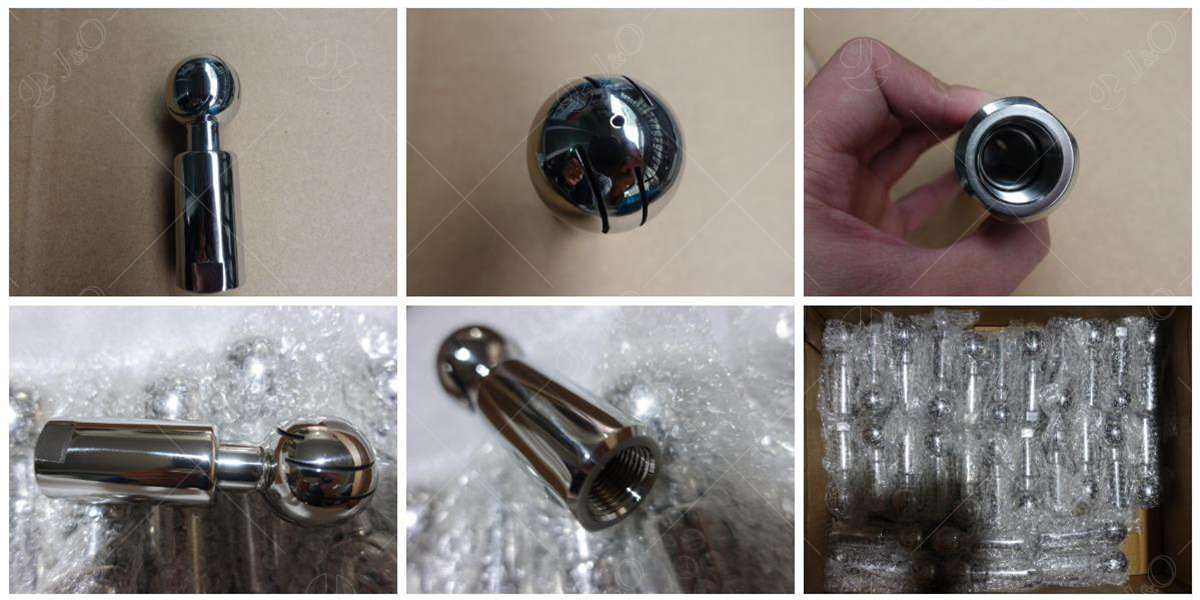
Spray Ball Tank Cleaning Cip Rotary
- Model:
- JOF-CBH002-33N
- Brand:
- J&O
- Material:
- SS304 or SS316L
- Connection:
- Female Thread
- Payment:
- T/T, L/C, Western Union


A spray ball distributes cleaning liquid across tank surfaces during Clean-in-Place (CIP) cycles. A rotary design uses cleaning-liquid pressure to rotate the spray head, creating a moving spray pattern across the vessel interior. Stainless steel construction in SS304 or SS316L suits hygienic process equipment, while the threaded connection provides a fixed mounting method.
Hydraulic Rotation and Spray Coverage
A rotary spray ball differs from a fixed spray ball because the spray head moves during operation. Angled orifices create hydraulic reaction force that drives rotation, allowing jets to reach different sections of the tank instead of remaining in fixed positions. This movement can increase repeated surface wetting during a CIP cycle.
Flow Conditions Affect the Cleaning Pattern
A cip spray ball needs suitable inlet pressure and flow to produce the intended spray reach. Tank diameter, internal volume, agitators, baffles, probes, and other obstructions can change the actual coverage. A spray pattern should therefore be considered together with pump capacity, piping size, and tank geometry rather than evaluated from the spray head alone.
| Operating factor | Effect on cleaning |
|---|---|
| Tank geometry | Determines required spray reach |
| Internal obstructions | Can create shadow areas |
| CIP flow rate | Influences jet reach and rotation |
| Inlet pressure | Affects spray intensity |
| Cleaning chemistry | Changes residue removal conditions |
Threaded Mounting for Tank Cleaning Systems
A threaded rotary spray ball suits vessels fitted with compatible threaded ports. The connection remains fixed during normal operation, while the spray head performs the cleaning movement inside the tank. Thread type, sealing method, installation position, and available clearance should match the vessel design.
Spray Ball Tank Cleaning Requires System Matching
Spray ball tank cleaning depends on the relationship between the spray device and the complete CIP system. Cleaning temperature, chemical concentration, flow rate, pressure, contact time, and residue type all affect cleaning performance. Installation checks should also confirm whether the spray pattern reaches surfaces located behind internal components.
FAQ About Rotary Tank Cleaning
How does a rotary spray ball create movement?
Angled spray openings generate reaction force that rotates the cleaning head.
What affects cip spray ball coverage?
Tank geometry, pressure, flow rate, internal obstructions, and spray reach all affect coverage.
When is a threaded spray ball suitable?
It suits tanks designed with compatible threaded ports where a fixed cleaning connection is required.
Technical Data
| Product Name: | Sanitary Rotary Cleaning Ball |
| Material: | SS304 or SS316L |
| Standard: | 3A, SMS, DIN,ISO,RJT... |
| Size: | 0.5"-2.5" or DN15-DN65 |
| Connection Way: | Weld, Clamp,Thread,Bolt... |
| Cleaning Radius: | 1.0-3.5 m |
| Surface Finishing: | Mirror or matt finish |
| Packing Details: | Usually bubble pack for each within carton box or plywood case, or special packaging upon customer requirements. |
Product Parameter

Product Pictures